When creating custom patches for clothing, uniforms, hats, bags, and branded merchandise, every detail matters. A company logo might include fine lettering, small symbols, intricate linework, or several colours that need to appear clear and professional. However, not every patch-making method can reproduce these elements equally well.
This is where woven patches offer a valuable solution.
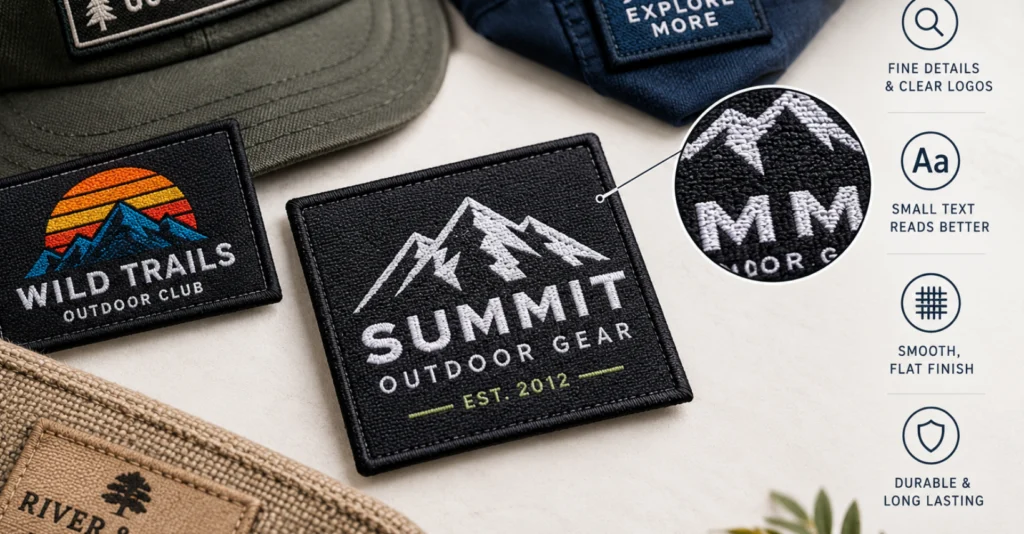
Woven patches are made by weaving fine threads together to create the design directly into the patch material. Unlike traditional embroidered patches, which use thicker decorative stitches on a fabric base, woven patches can accommodate finer details and smaller lettering in many designs. This makes them particularly useful for businesses, clothing brands, sports clubs, organisations, and individuals who want their logos to look sharp and easy to recognise.
At Custom Patch Makers UK, choosing the right patch type begins with understanding the design, its intended use, and the finish you want to achieve. Whether you are creating branded workwear, custom clothing labels, promotional merchandise, or detailed logo patches, woven patches can provide a clean and professional appearance.
In this guide, we will explain how woven patches work, why they are suitable for detailed logos and small text, how they compare with other patch types, and what to consider before ordering your custom design.
What Are Woven Patches?
Woven patches are custom fabric patches created by interlacing fine threads to form a design. The colours, shapes, lettering, and other visual elements are built into the woven structure rather than being produced primarily through raised embroidery stitches.
This production method allows manufacturers to reproduce intricate designs with a relatively smooth surface. Because the threads used in weaving can be finer than the thicker threads commonly used for embroidery, small details can often be represented more accurately.
Woven patches are frequently used for:
- Company logos and branded uniforms
- Clothing labels and fashion branding
- Detailed text and small lettering
- Promotional merchandise
- Sports clubs and team apparel
- Bags, jackets, hats, and accessories
- Event merchandise and commemorative designs
- Product branding and private-label clothing
The final result depends on several factors, including the artwork, thread colours, patch dimensions, weave density, and production capabilities. A well-prepared design gives the manufacturer a better opportunity to reproduce the intended details.
Woven patches are not automatically the best option for every design, but they are worth considering when clarity and fine detail are more important than a raised, textured appearance.
1. Why Woven Patches Work Well for Detailed Logos
A logo is more than a decorative graphic. It represents a business, organisation, product, or community. If the logo contains small lettering or delicate design elements, the patch must reproduce those features clearly enough for people to recognise the brand.
Woven patches are particularly useful for designs that include several small visual components.
Fine lines and intricate shapes
Some logos contain thin outlines, small geometric shapes, narrow borders, or detailed illustrations. With traditional embroidery, these elements may need to be simplified because thick stitches can make very small features difficult to reproduce.
Woven construction can accommodate finer visual details in many cases. This can help maintain the overall appearance of a logo without making every line thicker than intended.
For example, a clothing brand might use a logo containing a small mountain outline, a narrow circular border, and a compact symbol. A woven patch may reproduce these elements more cleanly than a conventional embroidered version, depending on the final size and production specifications.
More defined lettering
Business logos frequently include a name, slogan, or short descriptor. If the lettering is too small, individual characters can merge together or become difficult to read.
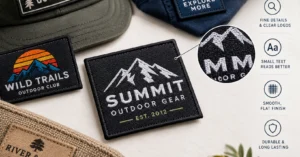
Woven patches can be a strong option for compact text because the fine thread structure supports detailed shapes. Letters can often retain more of their original proportions than they would with thicker embroidery stitches.
However, there is still a practical limit. Extremely small fonts, thin strokes, and tightly spaced characters may require adjustments before production. Increasing the patch size or simplifying the lettering can improve readability.
Cleaner visual presentation
Woven patches generally have a flatter surface than heavily embroidered patches. This creates a neat finish that works well for modern branding, minimalist graphics, and designs that depend on precise visual detail.
For brands that prefer a smooth, label-like appearance rather than a raised, textured finish, woven patches can be an attractive option.
2. Why Woven Patches Are Ideal for Small Text
Small text is one of the most common challenges in custom patch design. A logo may look perfect on a computer screen but become difficult to read when reduced to a patch only a few centimetres wide.
This happens because the physical production process has limitations. Fine lines need enough space to remain distinct, letters require sufficient separation, and the thread structure must represent each character clearly.
Woven patches can help address these challenges.
Better definition for compact lettering
Because woven designs use fine threads to form the image, they can often reproduce smaller lettering more effectively than traditional embroidery. This makes them useful for company names, product labels, short slogans, club names, and other compact text.
For example, a patch designed for a shirt pocket might include a small company logo alongside a short line of text. A woven construction can provide a smoother surface and more defined lettering for this type of application.
The outcome will still depend on the selected font, the number of characters, and the available patch area.
Improved spacing between characters
Letter spacing plays an important role in readability. When characters sit too close together, small text can appear crowded, especially after the design is converted into physical threadwork.
A woven patch can help preserve separation between characters when the artwork and production specifications allow it. Designers should still avoid unnecessarily tight kerning and extremely narrow fonts.
If your design includes a long company name or slogan, consider using a larger patch or removing non-essential text. A clear, simple design usually looks more professional than a crowded patch containing too much information.
Suitable for clothing labels
Woven patches are often used as brand labels on garments because they can combine compact text with a clean finish. Fashion brands may use them to display a brand name, collection identity, size information, or a small decorative symbol.
They can be suitable for jackets, shirts, hoodies, bags, and other textile products, depending on the chosen backing and attachment method.
For garments that require washing, the patch material, backing, stitching, and garment-care instructions should all be considered together.
3. Woven Patches vs Embroidered Patches
Woven and embroidered patches are both popular custom branding options, but they create different visual effects.
Embroidered patches are made by stitching thread onto a fabric base. Their raised threads create texture and depth, making them suitable for bold logos, traditional badges, and designs that benefit from a tactile appearance.
Woven patches form the design by interlacing threads. Their surface is generally smoother, which can make them more suitable for small lettering and intricate details.
Key differences
Woven patches
- Suitable for fine lines and detailed artwork
- Often better suited to small lettering
- Have a relatively flat, smooth finish
- Work well for clothing labels and compact logos
- Can provide a neat, modern branding appearance
Embroidered patches
- Provide a raised, textured finish
- Work well for bold symbols and larger lettering
- Create a traditional stitched appearance
- Are popular for uniforms, jackets, caps, and club badges
- Can emphasise shapes through stitch direction and thread texture
Neither method is universally superior. The right choice depends on the design and the look you want.
If your logo contains tiny lettering, fine outlines, or several intricate components, woven patches may be the better starting point. If your design features large text, thick borders, and bold symbols, embroidery may deliver the appearance you prefer.
For a more complex design, ask your patch manufacturer to review the artwork and recommend the most appropriate construction before production.
4. Woven Patches vs Printed Patches
Printed patches are another option for designs that require detailed imagery. Depending on the printing process, they can reproduce gradients, photographic elements, subtle colour transitions, and complex artwork that may be difficult to create using woven threads.
Woven patches offer a different benefit: the design is formed from threads rather than applied as printed ink or pigment.
Consider woven patches when you want a textile-based finish with fine lettering and a consistent woven appearance. Printed patches may be worth considering when your artwork relies heavily on photographic detail, smooth gradients, or colour effects that cannot easily be represented with a limited thread palette.
The best option depends on the artwork, expected use, desired texture, and production requirements.
Before deciding, compare a sample or production-ready mock-up if available. Viewing the design at its actual size is particularly useful when small text is involved.
5. The Best Uses for Detailed Woven Patches
Woven patches can support a wide range of branding and personalisation projects. Their ability to represent fine details makes them useful for applications where clarity is important.
Clothing brands and fashion labels
Fashion brands often need compact labels that communicate identity without overwhelming the garment. Woven patches can display a brand name, small icon, collection title, or short message in a clean format.
They can be incorporated into jackets, hoodies, shirts, denim, and accessories. The final placement and attachment method should suit the garment fabric and the intended care routine.
Corporate uniforms
Businesses may require logos that remain recognisable on shirts, jackets, aprons, or other workwear. Woven patches can be considered when the logo includes small lettering or a detailed symbol.
For uniforms, it is also important to think about colour consistency, durability, wash requirements, and how the patch will be attached.
Promotional merchandise
Companies frequently use patches on bags, event clothing, giveaways, and branded accessories. A well-designed woven patch can communicate a brand name or message in a compact area.
Because promotional items are often produced in batches, preparing clear artwork and approving a sample or mock-up can help avoid inconsistencies.
Clubs and organisations
Clubs, societies, and community groups may use woven patches for membership merchandise, jackets, bags, and event apparel. These designs can include names, small icons, dates, or other identifying information.
For complex crests, check that the smallest lettering and decorative details remain legible at the selected size.
Product branding
Woven patches can also be used to label bags, textile accessories, and selected apparel products. They offer brands an alternative to printed labels or heavily textured embroidery.
The appropriate construction depends on the product’s surface, expected handling, and attachment requirements.
6. How to Design a Woven Patch for Maximum Readability
Even a suitable patch type cannot compensate for artwork that contains too much information or lettering that is too small. A strong design makes the most of the available space.
Here are some practical ways to prepare artwork for woven patches.
Choose a readable font
Simple fonts generally perform better at small sizes than elaborate script or extremely thin typefaces. Choose lettering with clear character shapes and enough space between letters.
Avoid using several different fonts in a small design. A consistent typographic style creates a cleaner appearance and makes the logo easier to recognise.
Avoid overcrowding
Trying to fit a company name, slogan, website, phone number, and decorative graphics onto a small patch can make the final design difficult to read.
Focus on the most important information. For a logo patch, this is usually the brand name and main symbol. Secondary information can be displayed elsewhere on the garment or packaging.
Use contrasting colours
Strong contrast helps distinguish text from its background. Dark lettering on a light background, or light lettering on a dark background, can make small text easier to identify.
Colours that look distinct on a monitor may appear similar when translated into thread. Ask your manufacturer to confirm suitable thread colours, especially if your design contains several closely related shades.
Give fine details enough room
Narrow gaps, tiny shapes, and delicate outlines may not reproduce as intended if the design is too small. Increasing the patch dimensions or simplifying the artwork can improve the final result.
Do not assume that every detail visible in a large digital file will remain visible on a small physical patch.
Review the artwork at actual size
A logo can look clear when enlarged on a computer screen but become difficult to read at its intended dimensions.
Reduce the design to the actual patch size before approving it. Check the smallest lettering, internal spaces, thin lines, and any fine decorative features.
If something looks crowded at actual size, it may need to be adjusted before production.
Request a production review
An experienced patch maker can identify details that may be difficult to weave accurately. Sharing a high-quality image of your logo and explaining the intended patch dimensions gives the manufacturer a better basis for recommendations.
At Custom Patch Makers UK, customers can use this design-planning approach to help determine whether a woven patch is suitable for their artwork or whether another construction may deliver a better result.
7. Choosing the Right Size for a Woven Patch
Patch size directly affects how much detail can be included. A larger patch provides more space for letters, symbols, and decorative elements, while a smaller patch requires a more selective design.
There is no single size that works for every woven patch. The best dimensions depend on the shape of the logo, the number of characters, the intended placement, and the garment or accessory.
Small patches
Small patches can be useful for discreet branding on shirt pockets, sleeves, bags, and accessories. They work best when the design is simple and the text is limited.
If your logo includes a long name or several lines of small text, a very small patch may not be suitable.
Medium-sized patches
Medium-sized patches provide more flexibility for company names, symbols, and short text. They can be a practical choice for many clothing and merchandise applications.
However, the ideal dimensions still depend on the proportions of the design and the level of detail required.
Large patches
Large patches offer more room for elaborate logos, multiple design elements, and longer lettering. They may suit jackets, bags, uniforms, or statement pieces.
Larger dimensions do not automatically guarantee better results, but they can make detailed artwork easier to reproduce.
When requesting a quote, provide your preferred width and height, the intended placement, and a copy of the design. This allows the patch maker to assess whether the size is suitable.
8. Selecting Colours for Woven Patches
Colour selection affects both the appearance and readability of a custom patch. A design may use the correct brand colours but still be difficult to read if the foreground and background are too similar.
For detailed woven logos, colour planning should support the overall structure of the design.
Prioritise contrast
Make sure small lettering stands out from the background. If the text and background have similar brightness, the characters may be harder to distinguish.
A simple colour combination can sometimes communicate a brand more effectively than a large number of similar shades.
Keep the palette practical
Woven patches use threads to create the design, so the available colours and weaving process influence the final result. Complex gradients and subtle colour transitions may need to be simplified.
A limited, well-chosen palette can make a logo look more consistent and professional.
Consider brand consistency
If the patch will appear on uniforms or merchandise, choose colours that align with the rest of your branding. Provide colour references where available, while recognising that the final thread shades may not match a screen perfectly.
For important corporate branding, review the proposed colour selection before approving the order.
9. Which Backing Is Best for Woven Patches?
The backing determines how a patch can be attached to clothing or accessories. The right choice depends on the material receiving the patch, how frequently the item will be used, and whether the patch needs to be removed later.
Sew-on backing
Sew-on patches are attached with stitches. This is a versatile option for many garments and accessories, particularly when a secure attachment is important.
The sewing method and thread should be appropriate for the fabric. Delicate materials may require additional care to avoid damage.
Iron-on backing
Iron-on backing uses heat to activate an adhesive that bonds the patch to a suitable fabric. It can provide a convenient application method when the garment and patch backing are compatible.
Always follow the manufacturer’s instructions for temperature, pressure, and application time. Some fabrics cannot tolerate the heat required, and an iron-on patch may benefit from additional stitching depending on the application.
Hook-and-loop backing
Hook-and-loop backing, commonly known by the brand name Velcro, allows a patch to be attached and removed repeatedly. It can be useful for tactical gear, bags, equipment, and garments with compatible attachment panels.
This option is particularly helpful when the design needs to be changed or transferred between items.
Adhesive backing
Adhesive backing can be appropriate for certain temporary or light-duty applications, depending on the adhesive and surface. It should not automatically be treated as a substitute for permanent stitching on frequently washed clothing.
Before selecting a backing, tell your patch manufacturer how and where the patch will be used. This helps ensure that the attachment method is appropriate for the intended application.
10. Are Woven Patches Durable?
Woven patches can be durable, but their lifespan depends on more than the way the design is made. Thread quality, backing, edge finishing, attachment method, garment fabric, and everyday use all influence performance.
A patch used on a decorative bag may experience very different conditions from one attached to workwear that is washed regularly.
To help your woven patches last, consider the following:
- Choose a backing suited to the garment or accessory.
- Follow the manufacturer’s application instructions.
- Use appropriate stitching when a stronger attachment is needed.
- Follow the care instructions for the garment and patch.
- Avoid excessive heat unless the manufacturer confirms it is suitable.
- Inspect patches used on frequently handled equipment or workwear.
If you need patches for demanding environments, explain the expected conditions before ordering. The manufacturer can help you decide whether woven construction, embroidery, PVC, or another option is most appropriate.
It is also important to distinguish between the durability of the patch itself and the durability of its attachment. A well-made patch can still detach if the backing is unsuitable or it is incorrectly applied.
11. Common Mistakes to Avoid When Ordering Woven Patches
A little preparation can make the ordering process easier and help prevent disappointment.
Using artwork that is too small or unclear
Low-resolution images, blurry screenshots, and compressed files may not provide enough information for accurate reproduction. Whenever possible, supply a high-quality image or vector artwork.
If you only have a PNG or JPG, share the clearest version available and ask whether it is suitable for production.
Including too much text
Long slogans and multiple lines of tiny lettering can make a patch difficult to read. Prioritise the essential information and move secondary details to another part of the design.
Choosing colours with insufficient contrast
Similar foreground and background colours can cause text to disappear visually. Review the palette carefully and consider a more contrasting combination.
Ignoring the intended application
A patch designed for a lightweight shirt may not be ideal for heavy-duty equipment. Consider the surface, attachment method, washing requirements, and expected handling before placing an order.
Approving the design only when enlarged
Always check the artwork at its intended size. This is one of the easiest ways to identify lettering and spacing problems before production.
Failing to confirm the specifications
Before confirming an order, check the patch dimensions, shape, colours, border, backing, quantity, and any other requirements. Make sure the final proof reflects what you expect to receive.
12. How to Order Custom Woven Patches for Your Brand
Ordering custom woven patches should begin with a clear understanding of what you want to achieve. A few straightforward steps can help you communicate your requirements and choose the right finish.
Step 1: Prepare your logo
Gather the best available version of your logo or artwork. Include any important brand colours and let the patch maker know if certain text or symbols must remain unchanged.
Step 2: Decide on the patch dimensions
Choose a suitable width and height based on the intended placement. If you are unsure, explain where the patch will be used and ask for a recommendation.
Step 3: Select the patch construction
If your logo contains fine lettering or intricate details, ask whether woven construction is suitable. For bold, raised designs, embroidered patches may be worth considering. For flexible, moulded designs, PVC patches may be another option.
Step 4: Choose the backing and border
Decide whether the patch will be sewn on, ironed on, or attached using hook-and-loop backing. Also discuss the edge finish and shape.
Step 5: Review the proof
Check spelling, spacing, colours, dimensions, and small details. If the text is particularly fine, request that the design be assessed at actual size.
Step 6: Confirm the order details
Before production begins, confirm the quantity, agreed specifications, pricing, and estimated turnaround time. Clear communication helps everyone understand the expected result.
At Custom Patch Makers UK, the goal is to help customers make informed decisions about custom patches by considering the artwork, material, finish, and intended use together.
13. Why Woven Patches Can Be a Smart Branding Investment
A well-designed patch can help a business create a consistent visual identity across clothing, accessories, and promotional products. Woven patches can be especially useful when the brand depends on clear lettering and fine design elements.
They support a professional appearance
A clean patch design can help garments and merchandise look coordinated. This can be valuable for clothing brands, small businesses, clubs, and organisations that want their branding to appear consistent.
They can accommodate detailed artwork
Logos containing compact text, fine lines, or small symbols may benefit from woven construction. This can help maintain the intended appearance of a design within a limited area.
They suit a range of textile products
Depending on the backing and dimensions, woven patches can be used on many garments and accessories. This allows businesses to maintain a recognisable visual identity across different products.
They offer a different finish from embroidery
Not every brand wants a raised, heavily textured patch. Woven patches provide a smoother textile finish that can suit minimalist, modern, and label-style branding.
The value of a custom patch ultimately depends on its suitability for the product and the quality of its design and production. Selecting the right patch type from the beginning helps ensure that the finished item supports your brand rather than compromising its appearance.
Frequently Asked Questions About Woven Patches
Are woven patches better than embroidered patches for small text?
Woven patches are often a better choice for small lettering and fine details because their finer thread structure can reproduce compact designs more clearly. Embroidered patches are usually better suited to bold designs that benefit from a raised, textured finish. The best option depends on the artwork and finished size.
Can woven patches reproduce detailed logos?
Yes, woven patches can reproduce many detailed logos, including fine lines, small symbols, and compact lettering. However, the result depends on the artwork, patch dimensions, thread colours, and manufacturing capabilities. Some designs may still need simplification.
Are woven patches suitable for clothing labels?
Yes. Woven patches are commonly used for clothing labels and brand identification because they provide a relatively smooth finish and can accommodate small text. The appropriate backing and attachment method depend on the garment and care requirements.
Can woven patches be used on hats and bags?
They can be suitable for many hats, bags, and accessories, provided the patch dimensions, backing, and attachment method are appropriate for the material. Curved surfaces, such as some caps, may require additional consideration when selecting the patch size and construction.
Are woven patches washable?
Many woven patches can be used on washable garments, but wash performance depends on the materials, backing, attachment, and garment-care instructions. Check the manufacturer’s guidance before washing, especially when heat-applied backing is used.
Can I use my existing logo to make a woven patch?
In many cases, yes. A manufacturer can review your existing logo and advise whether it is suitable for weaving. Small lettering, thin lines, or complex colour effects may need adjustments to ensure that the final patch remains clear.
What file format should I provide for a custom woven patch?
A high-quality vector file is often useful because it can be scaled without losing clarity. Clear PNG or JPG files may also be suitable, depending on the design and production process. Ask the manufacturer to confirm the preferred format before submitting your artwork.
How do I choose the right size for a woven patch?
Consider where the patch will be placed, how much text it contains, and how easily the smallest details can be read. Check the artwork at actual size and ask the patch maker to review any fine lettering before production.
Are woven patches suitable for business logos?
Yes. Woven patches can be an excellent option for businesses that want a smooth, professional-looking logo patch with detailed lettering. They can be used for uniforms, branded apparel, promotional merchandise, and selected textile products.
Conclusion
Woven patches are a smart option for many designs that depend on detailed logos, fine lines, and small text. Their woven construction creates a relatively smooth finish and can help reproduce compact lettering more clearly than traditional embroidery in suitable designs.
They are particularly worth considering for clothing labels, company branding, uniforms, promotional merchandise, bags, and accessories. However, successful results depend on more than selecting the right patch type. Artwork quality, font choice, colour contrast, patch size, backing, and intended use all play an important role.
Before ordering, review your logo at actual size, simplify unnecessary details, and discuss any small lettering with your manufacturer. Comparing woven patches with embroidered and printed alternatives can also help you choose a finish that suits your brand.
At Custom Patch Makers UK, careful planning is the starting point for creating custom patches that communicate your design clearly. If your logo includes fine details or compact text, woven patches are worth exploring as part of your next custom patch project.