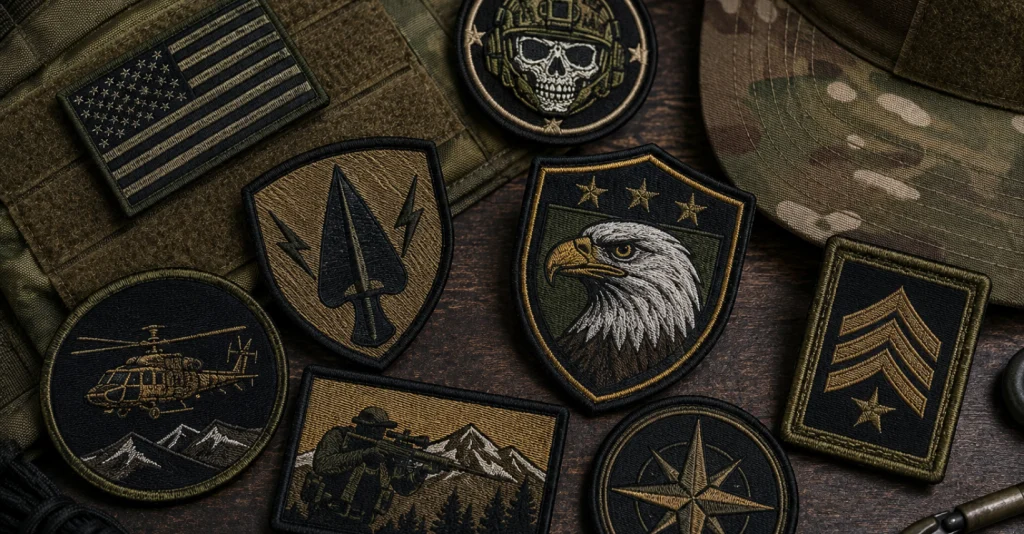
Military patches are more than decorative pieces added to a uniform or tactical bag. They can represent a unit, identify a role, recognise service, display a morale design, or carry a symbol that has real meaning to the people wearing it. Because of that, a military patch needs to do more than look good when it is brand new. It needs to remain clear, secure, and presentable after repeated wear.
Field environments can be demanding. Uniforms and equipment may be exposed to rain, mud, dust, sunlight, sweat, friction, frequent movement, and repeated cleaning. A patch that is made without considering these conditions can begin to fray, lose its colour, separate from its backing, or become difficult to read.
That is why material selection, embroidery quality, edge finishing, backing, and overall construction matter when ordering custom military patches.
At Custom Patch Makers UK, we create custom patches in a range of styles and materials, including embroidered, PVC, woven, and other custom options. Our military and tactical patch solutions are designed around the artwork, application, size, backing, and appearance required for the project.
Whether you are ordering patches for a military organisation, veterans’ group, tactical team, airsoft community, outdoor group, or a clothing project inspired by military design, choosing the right construction can make a significant difference.
Why Durability Matters for Military Patches
A patch may appear simple, but it has several components working together. The base fabric, stitching, border, backing, thread, adhesive or attachment system, and artwork all contribute to the finished product.
In everyday clothing, a patch might experience occasional movement and washing. Field equipment can face considerably more demanding conditions. A patch attached to a tactical vest, backpack, jacket, or other frequently used equipment can experience constant rubbing and repeated handling.
Consider how often tactical equipment is moved, packed, unpacked, adjusted, cleaned, and transported. Every one of these activities can place stress on a patch.
A high-quality military patch should therefore be designed with its intended environment in mind.
Durability is especially important when:
- A patch will be worn frequently.
- The patch will be attached to outdoor equipment.
- The design will be exposed to sunlight.
- The patch will experience repeated cleaning.
- The patch will be removed and reattached regularly.
- The patch is being produced in large quantities.
- The patch represents an organisation or group where consistency matters.
- Small lettering or symbols need to remain easy to identify.
A good-looking patch is only the starting point. The objective is to create a patch that continues to perform and maintain its appearance after the initial excitement of receiving the order has passed.
What Makes a Military Patch High Quality?
There is no single feature that determines whether a patch is durable. Quality comes from the combination of materials and manufacturing decisions.
Some of the most important factors include:
1. Suitable Patch Material
The base material should match the intended use. Embroidery, PVC, and woven construction each have different visual and practical characteristics.
2. Strong Construction
The stitching, border, and attachment method should be designed to work together rather than treated as separate details.
3. Appropriate Backing
Hook-and-loop backing is particularly useful when a patch needs to be removed and changed. Sew-on construction is suitable where a permanent attachment is preferred.
4. Clear Artwork
A complicated design may need to be simplified so that important details remain recognisable at the final patch size.
5. Reinforced Edges
The border protects the perimeter of the patch and contributes to its finished appearance.
6. Consistent Production
For bulk orders, consistency in size, colours, borders, and artwork is important, especially when multiple members of the same organisation will wear the patches.
The manufacturing process should begin with the intended application rather than simply asking, “What patch looks best?”
The better question is:
What patch construction will work best for where and how this patch will be used?
Embroidered Military Patches: A Traditional Choice
Embroidered patches remain one of the most recognisable patch styles. They use thread stitched into a fabric base to create the artwork, producing a textured surface that has a traditional appearance.
This style works particularly well for designs where the embroidered texture is part of the desired aesthetic.
High-quality embroidery depends heavily on stitch density, thread selection, artwork preparation, and production accuracy. If a design contains tiny lettering or very fine details, the artwork may need to be adjusted before production to ensure that those elements remain readable.
One of the advantages of embroidered military patches is their classic appearance. The raised thread gives the design dimension and creates the familiar patch look associated with uniforms, jackets, bags, and organisational apparel.
Custom Patch Makers UK offers custom embroidered patches as one of its core patch options, alongside other styles for customers who need different visual or functional characteristics.
When Should You Choose Embroidery?
Embroidered patches can be a strong option when you want:
- A traditional military-inspired appearance
- Visible thread texture
- Strong colour definition
- A professional uniform look
- Unit or organisation insignia
- Veteran or commemorative designs
- Jacket and apparel patches
- A classic custom patch aesthetic
For designs with extremely small details, however, another construction may be more suitable.
PVC Military Patches for Demanding Environments
PVC patches have become a popular option for tactical and outdoor applications because their construction differs from traditional thread-based embroidery.
PVC is a flexible synthetic material that can produce clean shapes, raised details, recessed elements, and strong visual contrast. Unlike an embroidered patch, there are no individual embroidery threads exposed across the surface.
This makes PVC particularly attractive for designs that need a modern tactical appearance.
Custom Patch Makers UK describes its PVC patches as weather-resistant and suitable for tactical gear, outdoor equipment, backpacks, and long-lasting applications.
PVC can also be practical when the patch is likely to encounter dirt or moisture because its surface can generally be wiped clean more easily than a textured embroidered surface.
Advantages of PVC Military Patches
PVC can be a good choice for:
- Tactical equipment
- Outdoor gear
- Backpacks
- Plate-carrier-style equipment
- Morale patches
- Modern unit designs
- Bold logos
- Designs with raised details
- Applications where easy cleaning is useful
Another advantage is visual consistency. PVC allows designers to create strong outlines and defined shapes without depending on individual embroidery stitches.
If your design has a modern, tactical, or three-dimensional appearance, PVC is worth considering.
Woven Military Patches for Fine Detail
Woven patches are produced differently from traditional embroidered patches. Instead of creating the design primarily through raised embroidery stitches, woven construction uses tightly woven threads to create a smoother surface.
This makes woven patches particularly useful when artwork contains smaller lettering or intricate lines.
Custom Patch Makers UK offers woven patches for designs where precision and detailed artwork are important.
A woven surface can provide a cleaner appearance for certain designs because the finished patch has less of the raised texture associated with heavy embroidery.
Woven Patches Are Useful For:
- Detailed logos
- Small lettering
- Intricate symbols
- Name patches
- Identification designs
- Multi-element artwork
- Designs where a smooth surface is preferred
The key is to match the patch type to the artwork. A design with large, bold shapes may look excellent in PVC or embroidery, while a design containing finer lines may benefit from woven construction.
Choosing the Right Backing for Field Use
The front of a military patch gets most of the attention, but the back is equally important.
You can have a beautifully produced patch that fails in practical use if its attachment method is unsuitable for the application.
The main backing choices include:
- Hook-and-loop backing
- Sew-on backing
- Iron-on backing
- Adhesive backing
The best option depends on whether the patch needs to be permanent, removable, interchangeable, or temporary.
Hook-and-Loop Backing
Hook-and-loop backing is one of the most practical options for tactical applications.
It allows the patch to be removed and replaced without sewing a new patch onto the garment or equipment. This is useful when users need to change identification patches, rotate designs, or move a patch between compatible pieces of gear.
Custom Patch Makers UK specifically offers custom Velcro patches for military gear, tactical uniforms, airsoft teams, and outdoor users.
For removable patches, backing quality matters. Repeated attachment and removal puts stress on the connection, so the backing should be selected according to how frequently the patch will be handled.
Sew-On Backing
Sew-on patches provide a more permanent attachment.
They can be particularly suitable for uniforms, jackets, bags, and garments where the patch is not expected to be removed regularly.
A sewn attachment does not depend solely on an adhesive layer. Once properly stitched into the garment, it can provide a strong long-term connection.
For permanent applications, sew-on construction is often the straightforward choice.
Iron-On Backing
Iron-on patches use heat-activated adhesive to attach the patch to fabric.
They are convenient and can be suitable for apparel and lighter applications. However, for equipment subjected to intense friction, repeated washing, or demanding outdoor conditions, it is important to consider whether an adhesive-only attachment is appropriate.
For particularly demanding use, a sewn attachment may provide additional security.
Adhesive Backing
Self-adhesive backing is generally better suited to temporary applications than heavy field use.
It can be useful when a patch needs to be attached quickly or displayed temporarily, but it should not automatically be considered the best option for demanding tactical environments.
Choosing backing based on convenience alone can create problems later.
Why the Border of a Military Patch Matters
The edge of a patch may look like a minor design feature, but it has an important role.
The border helps define the shape and contributes to the structural finish of the patch. A poorly finished edge can become one of the first areas to show wear.
A high-quality patch should have an edge that complements the construction and protects the perimeter.
Common approaches include:
- Stitched borders
- Merrow-style borders
- Clean-cut edges
- Laser-cut construction for selected designs
- Moulded PVC edges
The appropriate choice depends on the material and design.
Embroidered Borders
For embroidered patches, a stitched border can create a strong visual frame around the artwork while helping finish the perimeter.
It can also make the patch appear more complete and professional.
PVC Borders
PVC patches can incorporate the border directly into the moulded design. This creates a clean and durable perimeter around the patch.
Why Weak Edges Cause Problems
If the edge is poorly finished, repeated friction can lead to visible wear.
The patch may begin to look untidy even when the central artwork remains intact.
This is why experienced patch manufacturing should consider the entire construction rather than concentrating only on the artwork.
Designing Military Patches for Real-World Use
A durable patch begins with a good design.
One of the biggest mistakes people make is trying to fit too much information into a small patch.
A design may look excellent on a computer screen but become difficult to reproduce when reduced to its final physical size.
Before production, consider:
- Patch dimensions
- Letter height
- Line thickness
- Number of colours
- Border width
- Shape
- Material
- Backing
- Intended viewing distance
- Intended application
Keep Important Elements Simple
If your patch contains a unit name, emblem, number, slogan, and several decorative elements, you need to make sure they can coexist at the chosen size.
Small text can become particularly challenging.
Instead of shrinking everything to fit, consider simplifying the design.
For example, you might:
- Remove unnecessary decorative lines.
- Increase the size of important lettering.
- Reduce the number of tiny elements.
- Strengthen the main outline.
- Increase contrast between background and artwork.
- Simplify complicated symbols.
A simpler patch often looks stronger from a distance.
Colour Selection for Military Patches
Colour plays an important role in both appearance and readability.
A military or tactical patch does not necessarily need a large number of colours to look impressive. In many cases, a controlled colour palette creates a stronger result.
For tactical-inspired designs, customers may prefer subdued colours, neutral backgrounds, or high-contrast combinations.
However, the correct colour palette ultimately depends on the purpose of the patch.
Consider Contrast
If the background and artwork are too similar in tone, details may disappear.
Strong contrast helps important elements remain visible.
For example, light lettering against a dark background generally creates a stronger visual separation than two similar shades.
Think About the Material
Colours may appear differently depending on whether the design is embroidered, woven, or produced in PVC.
That is why reviewing a digital proof before production is valuable. Custom Patch Makers UK provides digital proofs so customers can review their design before manufacturing begins.
Size Matters More Than You Might Think
There is no universal “best” military patch size.
The correct size depends on where the patch will be attached and how much artwork it contains.
A small name patch may need very different dimensions from a large morale patch or organisational emblem.
Before selecting the final size, ask:
Where will the patch go?
Then ask:
How much information needs to fit inside it?
Finally:
Will the artwork remain clear at that size?
These questions can prevent many design problems.
Small Patches
Small patches are useful when space is limited or when the design needs to remain compact.
However, small dimensions can make detailed artwork more difficult to reproduce.
Medium Patches
Medium-sized patches offer a useful balance between visibility and practicality.
They provide more room for logos, symbols, lettering, and borders.
Large Patches
Large patches can accommodate more detailed artwork and can make a strong visual statement.
They may be particularly suitable for jackets, bags, display pieces, and larger areas of clothing.
The ideal size should always be determined by the application rather than selected randomly.
How Field Conditions Affect Patch Performance
A patch that looks perfect indoors may face completely different conditions outside.
Sunlight
Long periods of direct sunlight can affect some dyes and materials over time.
If a patch is intended for outdoor use, colour selection and material choice should be considered carefully.
Rain and Moisture
Water exposure can affect different patch constructions in different ways.
PVC is naturally attractive for applications where resistance to moisture is important. Embroidered and woven patches can also be used outdoors, but their construction should be appropriate for the intended environment.
Dirt and Mud
Field equipment can quickly become dirty.
A patch with a surface that is easy to clean can be advantageous for tactical and outdoor gear.
This is one reason PVC patches are popular for certain outdoor applications.
Friction
Friction may be one of the biggest challenges for patches used on equipment.
A patch attached to a backpack, tactical vest, jacket, or other frequently handled item can rub against straps, clothing, vehicles, and other gear.
The edge, stitching, backing, and material all contribute to how well the patch handles this repeated contact.
Repeated Washing
Cleaning is another factor.
A patch that is expected to remain on a garment during frequent washing should be constructed with the washing process in mind.
Where practical, removable hook-and-loop patches can be taken off before washing, helping protect both the patch and the garment.
Military Patches vs. Morale Patches
Military patches and morale patches can overlap in appearance, but their purposes may be different.
Military-style identification patches are often created around names, units, symbols, ranks, organisations, or other forms of identification.
Morale patches are typically more expressive. They may feature humour, artwork, slogans, mascots, or designs created to represent the personality of a group.
Both can benefit from durable construction.
For morale patches used on tactical equipment, PVC is often an appealing option because it can create bold shapes and modern raised details.
For traditional designs, embroidery may provide the classic appearance many customers prefer.
The important thing is not whether one material is universally “better.” It is whether the material matches the patch’s purpose.
Military Patches for Veterans’ Organisations
Military patches are not limited to active-use equipment.
Veterans’ organisations, reunions, associations, and commemorative projects may also use custom patches to preserve memories and recognise shared experiences.
For these applications, the patch may be worn on:
- Jackets
- Bags
- Caps
- Display boards
- Club apparel
- Commemorative garments
- Event merchandise
The design may include a unit emblem, date, location, name, symbol, or other meaningful artwork.
Because these patches can have significant sentimental value, quality remains important even when the patch is not being used in a field environment.
A well-made patch can become something that is kept and worn for years.
Military Patches for Airsoft and Tactical Communities
Military-inspired patches are also widely used outside traditional military settings.
Airsoft teams, tactical hobbyists, outdoor groups, collectors, and shooting-sports communities often create custom patches to identify teams or express personality.
Custom Patch Makers UK lists airsoft and paintball patches among its patch applications and offers removable Velcro-style options suitable for tactical equipment.
For these users, the design possibilities can be broad.
A team may want:
- A custom mascot
- Team initials
- A flag-inspired design
- A call sign
- A morale slogan
- A fictional unit emblem
- A custom number
- A tactical symbol
PVC, embroidery, and woven construction can all work depending on the desired look and level of detail.
Why a Digital Proof Is Important
Before a patch enters production, the artwork should be checked carefully.
A digital proof provides an opportunity to identify potential problems before materials are committed.
Look closely at:
- Spelling
- Numbers
- Names
- Colours
- Dimensions
- Border thickness
- Lettering
- Symbol placement
- Backing
- Overall shape
A small error in a digital file is much easier to correct than an error discovered after hundreds of patches have been manufactured.
Custom Patch Makers UK includes digital proofs as part of its production process, allowing customers to review the design before manufacturing.
This is particularly useful for military and organisational patches where names, numbers, insignia, or other details need to be accurate.
Why Bulk Patch Consistency Matters
When ordering a large quantity of military patches, consistency becomes just as important as durability.
Imagine receiving a batch where:
- Some patches are slightly larger.
- Borders vary in thickness.
- Colours do not match.
- Lettering differs between patches.
- The backing is inconsistent.
- Some patches have sharper details than others.
Even small differences can become noticeable when the patches are placed next to one another.
Professional production should aim for consistent dimensions, colours, artwork, borders, and construction throughout the order.
This is particularly important for units, teams, organisations, and groups where multiple people need matching patches.
Custom Patch Makers UK provides custom patch manufacturing for both smaller and larger requirements and highlights consistency, quality materials, and production quality as part of its service approach.
How to Make Your Military Patch Last Longer
Choosing quality materials is only part of the process. Proper care can also help extend the useful life of a patch.
1. Choose the Correct Backing
If the patch needs to be removed regularly, hook-and-loop backing is generally more practical than permanent attachment.
If the patch will remain on a garment, sew-on construction may be more appropriate.
2. Follow Care Instructions
Cleaning methods should be suitable for the garment and patch material.
Avoid unnecessary harsh treatment when it is not required.
3. Inspect the Edges
If you notice an edge beginning to lift or fray, addressing the problem early can prevent further deterioration.
4. Remove Interchangeable Patches Before Washing
If you use removable hook-and-loop patches, taking them off before laundering can reduce unnecessary wear.
5. Store Unused Patches Properly
Keep spare patches clean and dry. Avoid placing heavy objects on top of them for long periods.
6. Select the Material According to Use
Do not choose embroidery simply because it is traditional or PVC simply because it is popular. Think about where the patch will be used and what conditions it will face.
Common Mistakes When Ordering Military Patches
Choosing the Cheapest Option
Price is important, but the cheapest patch is not necessarily the most economical choice.
If a low-cost patch needs to be replaced repeatedly, the total cost can become higher than investing in better construction from the beginning.
Using Too Much Detail
Complex artwork may lose clarity when reproduced at a small size.
Simplifying the design can often create a stronger finished patch.
Ignoring the Backing
The patch may be excellent, but if the backing does not suit the application, the overall product will not perform as expected.
Selecting Material Without Considering Use
Embroidery, woven, and PVC patches have different strengths and visual characteristics.
Choose based on the environment and design.
Skipping the Proof
Always review the artwork carefully before production.
A digital proof provides a final opportunity to catch mistakes.
Forgetting About the Border
The border contributes to the appearance and durability of the finished patch.
It should be considered during the design stage.
What Should You Ask a Military Patch Manufacturer?
Before placing an order, it is worth asking a few practical questions.
What Material Do You Recommend?
Explain how the patch will be used. A manufacturer can then recommend a suitable construction.
What Backing Options Are Available?
Ask whether hook-and-loop, sew-on, iron-on, or other backing options are available.
Can You Produce Small Text?
If your design contains names, numbers, or detailed lettering, make sure the chosen construction can reproduce it clearly.
Will I Receive a Proof?
A proof allows you to confirm the design before manufacturing.
Can You Produce Different Sizes?
If you need patches for multiple applications, size flexibility can be important.
Can You Handle Repeat Orders?
For organisations that need patches over an extended period, maintaining consistency between orders is valuable.
What Is the Expected Production Process?
Understanding the process from artwork submission to proof approval and manufacturing makes ordering easier.
The Custom Patch Makers UK Approach
At Custom Patch Makers UK, our goal is to turn custom artwork into professionally manufactured patches suited to the customer’s requirements.
We offer multiple patch styles, including embroidered, woven, PVC, leather, chenille, sublimated, 3D embroidery, and other custom constructions. This gives customers the flexibility to select a patch style based on their artwork and intended use.
For military and tactical projects, we understand that the patch needs to be more than visually attractive.
It needs to fit the application.
That means considering:
- Material
- Patch size
- Artwork
- Colour
- Border
- Backing
- Intended use
- Required quantity
- Desired appearance
Our process begins with your artwork, sketch, logo, inspiration image, or concept. The design can then be reviewed through a digital proof before production. After approval, the patches move into manufacturing and quality control.
This approach helps reduce avoidable mistakes and ensures that the finished product reflects the approved design.
How to Order Custom Military Patches
Ordering custom military patches does not need to be complicated.
Step 1: Prepare Your Artwork
Send your logo, emblem, drawing, sketch, or reference image.
Do not worry if the artwork is not perfect. A professional patch manufacturer can advise you on adjustments needed for production.
Step 2: Explain the Application
Tell the manufacturer where the patch will be used.
For example:
- Tactical vest
- Uniform
- Jacket
- Backpack
- Outdoor equipment
- Team gear
- Veteran apparel
This information helps determine the most appropriate material and backing.
Step 3: Select Your Material
Choose between embroidery, PVC, woven, or another suitable patch style.
If you are unsure, ask for a recommendation based on your intended use.
Step 4: Choose the Backing
Decide whether you need removable hook-and-loop backing or a permanent attachment such as sew-on.
Step 5: Confirm Size
Make sure the patch dimensions work with the area where it will be attached.
Step 6: Review the Proof
Check every detail carefully.
Look at spelling, colours, dimensions, lettering, border, and artwork placement.
Step 7: Approve Production
Once the proof is correct, production can begin.
Step 8: Quality Check
The finished patches should be inspected for consistency and overall construction before being supplied.
How to Choose Between Embroidery, PVC and Woven Patches
Still unsure which material is right for your project?
Use the following general guide.
Choose Embroidery If:
You want a traditional stitched appearance, textured surface, and classic patch aesthetic.
Choose PVC If:
You need a modern tactical appearance, easy-clean surface, flexible construction, and a material suitable for outdoor-oriented applications.
Choose Woven If:
Your artwork contains fine lines, small lettering, or intricate details and you prefer a smoother surface.
Choose Hook-and-Loop Backing If:
You want to remove and replace the patch regularly.
Choose Sew-On If:
You want a more permanent attachment.
There is no single material that is ideal for every project. The best choice is the one that matches the artwork and application.
Quality Should Be Part of the Design From Day One
A common mistake is treating durability as something that can be added after the artwork has been completed.
In reality, durability should influence the design from the beginning.
If you know that a patch will be used outdoors, you can choose a suitable material before finalising the artwork.
If you know the patch needs to be removable, you can plan for hook-and-loop backing.
If you know that the patch will be small, you can simplify the artwork before production.
If you know that the patch will be washed frequently, you can consider how the attachment method and material will respond to repeated cleaning.
This approach results in a much more practical final product.
Final Thoughts
A high-quality military patch should be designed to do more than make a uniform or piece of equipment look better.
It should communicate identity clearly, remain securely attached, and maintain its appearance through the conditions it is expected to face.
The right combination of material, stitching, border, backing, artwork, and size can make a major difference.
For traditional designs, embroidered military patches offer a familiar textured appearance. For tactical and outdoor applications, PVC can provide a modern and practical construction. Woven patches can be useful when fine artwork and small details need to remain clear.
Backing is equally important. Hook-and-loop provides flexibility for removable patches, while sew-on construction offers a permanent attachment for applications where the patch is expected to stay in place.
Most importantly, the patch should be designed around its actual purpose.
At Custom Patch Makers UK, we provide custom patch solutions for military organisations, veterans’ groups, tactical communities, airsoft teams, outdoor users, businesses, clubs, and other organisations. Our range includes embroidered, PVC, woven, Velcro, and other custom patch options, with digital proofing available before production.
If you have a military patch design ready to manufacture, start by considering three things: where the patch will be used, what conditions it will face, and how you want it to look.
Once those decisions are clear, selecting the right material and backing becomes much easier.
A military patch may be small, but it can represent something much bigger. That is why quality, accuracy, and durability should never be treated as optional.
Ready to create your own military patches? Get a Custom Patch Quote from Custom Patch Makers UK and share your artwork, preferred size, quantity, material, and backing requirements.
Frequently Asked Questions
What is the best material for military patches?
There is no single best material for every application. Embroidered patches are a traditional choice, PVC works well for many tactical and outdoor applications, and woven patches can be useful for detailed designs. The right option depends on the artwork and intended use.
Are PVC patches suitable for tactical gear?
PVC patches can be a strong option for tactical and outdoor equipment. They offer a modern appearance and a surface that is convenient to clean, making them popular for applications where durability and practicality are important.
Are embroidered military patches durable?
High-quality embroidered patches can provide excellent durability when produced with suitable materials, stitching, and edge finishing. Their performance also depends on the environment and how the patch is attached.
Is Velcro backing good for military patches?
Hook-and-loop backing is particularly useful when patches need to be removed, replaced, or transferred between compatible pieces of equipment. The quality of the hook-and-loop material is important for applications involving frequent use.
Should military patches be sewn on?
Sew-on backing is a good option when a permanent attachment is preferred. It can be suitable for uniforms, jackets, bags, and other garments where the patch does not need to be removed regularly.
Are iron-on patches suitable for field use?
Iron-on backing can be convenient for clothing and lighter applications, but demanding field conditions may call for a more secure attachment. For heavy use, the application and material should be considered before choosing adhesive-only backing.
How do I make small military patch designs readable?
Keep the artwork simple, use strong contrast, avoid extremely thin lines, and make important lettering large enough for the final patch dimensions. A digital proof can help identify potential readability problems before production.
Can I order custom military patches in different shapes?
Yes. Custom patches can be produced in different shapes depending on the chosen manufacturing method and artwork. Custom Patch Makers UK offers custom patch designs tailored to different requirements.
Can military patches be used on backpacks?
Yes. Military-style patches are commonly used on backpacks and other gear. For removable applications, hook-and-loop backing can be particularly convenient.
How do I get started with a custom military patch order?
Start by sending your artwork or concept and explaining where the patch will be used. Include your preferred size, quantity, material, and backing if you already know them. The design can then be reviewed and prepared for production.