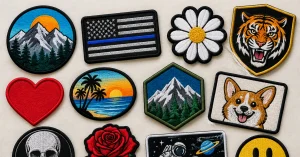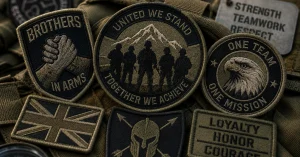
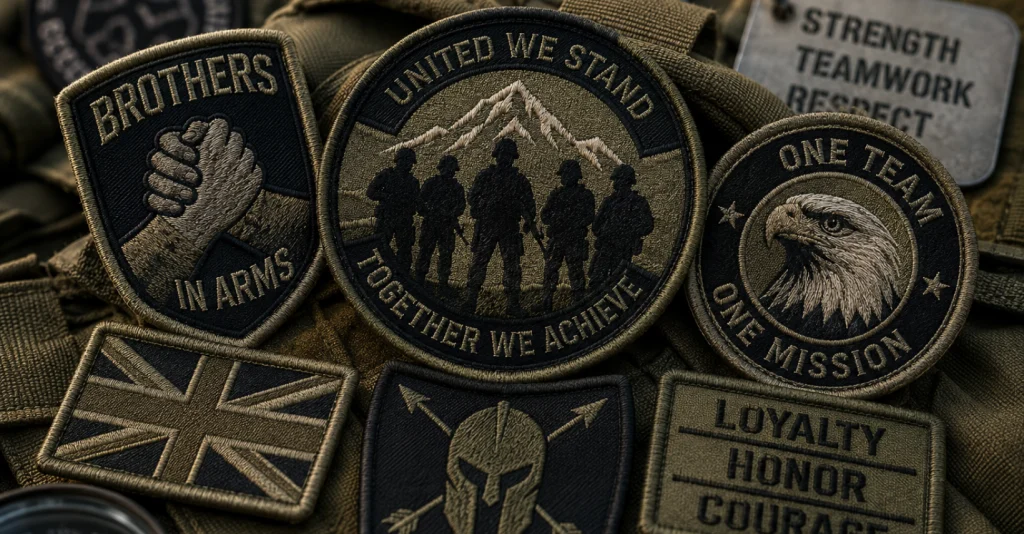
Military patches are much more than pieces of embroidered fabric attached to a uniform, jacket, bag, or piece of tactical equipment. For generations, they have represented identity, belonging, achievement, history, and shared experiences. A small patch can communicate something meaningful about the person wearing it and, perhaps more importantly, about the group they belong to.
In military environments, where teamwork, trust, discipline, and cooperation are essential, symbols can have a powerful effect. A shared insignia can remind individuals that they are part of something larger than themselves. It can represent a unit’s history, reflect its values, commemorate an important event, or simply provide a visual connection between people who have trained and worked together.
Military patches have also evolved beyond formal identification. Today, custom military patches and morale patches are used to express unit pride, celebrate achievements, preserve memories, and strengthen relationships among members of a team.
At Custom Patch Makers UK, we understand that a patch is not simply about thread, fabric, and stitching. The best patch designs tell a story. Whether you need a unit patch, military-style emblem, commemorative patch, deployment patch, or morale patch, the design can become a lasting representation of the people and experiences behind it.
In this guide, we’ll explore the important role military patches play in unity and togetherness, how they developed, what makes them meaningful, and how custom patches can help groups create a stronger shared identity.
What Are Military Patches?
Military patches are embroidered, woven, PVC, or otherwise manufactured insignia designed to represent a military unit, organisation, achievement, event, or shared identity.
Official military patches may communicate information such as:
- Unit affiliation
- Division or brigade identity
- Regiment or squadron
- Military branch
- Deployment history
- Qualification or specialty
- Awards or achievements
- Command relationships
Alongside official insignia, military culture has also developed a tradition of morale patches. These are generally more personal and expressive, often featuring humour, symbols, slogans, mascots, or references that have a particular meaning to a group.
The distinction is important: not every custom military-style patch is an official military insignia, and rules governing what can be worn on an official uniform vary by service and organisation.
Regardless of the specific type, patches have something important in common: they create visual identity.
A group of individuals can have different backgrounds, personalities, and responsibilities, but a shared emblem gives them something recognisable that connects them.
A Brief History of Military Patches and Unit Identity
The use of symbols to distinguish groups has existed for centuries. Armies and fighting forces historically used banners, shields, colours, badges, and other visual identifiers to communicate allegiance and distinguish one group from another.
Modern military patches developed significantly during the twentieth century. In the United States, for example, shoulder sleeve insignia became associated with military divisions during the First World War. The 81st Division’s distinctive insignia became an important early example of a unit symbol, and the tradition expanded considerably afterward.
By the Second World War, military patches were widespread and could incorporate a remarkable variety of symbols and imagery. Unit insignia increasingly became associated with history, pride, achievement, and identity rather than simple identification alone.
Over time, unofficial morale patches also developed their own culture. These patches provided an opportunity for service members to express humour, personality, shared experiences, and group identity.
This history demonstrates an important principle:
A patch can turn an abstract group identity into something people can actually see and carry with them.
How Military Patches Create a Sense of Belonging
One of the strongest functions of a military patch is its ability to communicate belonging.
Humans naturally create communities around shared experiences and identities. A military unit is no different. Members train together, face challenges together, and work toward common objectives. A shared emblem provides a physical reminder of that relationship.
When several people wear the same patch, they immediately share a visual connection.
The patch effectively says:
“We are part of the same group.”
That simple message can be surprisingly powerful.
A person might join a unit as an individual, but over time they become part of a collective identity. The patch becomes one small representation of that transformation.
It can represent:
- Shared training
- Shared responsibilities
- Shared challenges
- Shared achievements
- Shared memories
- Shared values
- Shared history
This is why military patches can become deeply personal even though they are relatively small objects.
1. Military Patches Strengthen Group Identity
Every successful group needs some form of identity.
For military units, identity can come from a combination of history, traditions, values, leadership, accomplishments, and symbols. A distinctive patch brings many of those elements together visually.
A strong patch design may incorporate a:
- Unit mascot
- Animal
- National symbol
- Landmark
- Historical reference
- Motto
- Number
- Initials
- Geographic symbol
- Military emblem
- Date
- Distinctive shape
Each element can communicate something about the group.
For example, an eagle may represent strength or freedom. A mountain might represent a geographic connection or resilience. A historical symbol may reflect the origins of a unit.
The meaning doesn’t necessarily need to be obvious to everyone.
In fact, some of the most meaningful patches contain symbols whose significance is understood primarily by the people who belong to the group.
That creates a kind of visual language.
2. Patches Encourage Camaraderie
Camaraderie is one of the most important aspects of a close-knit group.
People who have shared difficult experiences often develop relationships that extend beyond ordinary professional connections. A military patch can become a symbol of those relationships.
Morale patches in particular have historically been associated with humour, personal expression, and group camaraderie. Their designs can provide an informal way for members to recognise shared experiences and build connections.
A patch might contain an inside joke that means nothing to an outsider but immediately makes another member smile.
That is part of its value.
The patch creates a shared reference point.
Someone sees it and understands:
“You were there too.”
That recognition can help strengthen relationships.
3. Shared Symbols Promote Team Spirit
Team spirit isn’t created by a logo alone. It develops through relationships, leadership, shared experiences, and common goals.
However, visual symbols can reinforce that spirit.
Military patches provide a physical representation of the team. When members see the same emblem on uniforms or equipment, they are reminded of their collective identity.
This can be particularly meaningful during demanding periods.
The symbol becomes a reminder that an individual is not working alone.
The idea of visual symbolism contributing to cohesion is also recognised in military analysis. Research and commentary around military unit insignia have highlighted the relationship between symbols, pride, identity, and unit cohesion.
A well-designed patch therefore has a role beyond decoration.
It can become part of the culture of a group.
4. Military Patches Preserve Shared History
A military unit’s history can span years or even decades.
Personnel change. Leaders change. Equipment changes. Locations change.
But symbols can remain.
A patch can preserve part of that history.
Consider a commemorative patch created for:
- A deployment
- A training exercise
- A major anniversary
- A unit milestone
- A reunion
- A retirement
- A special operation
- A significant achievement
- A memorial event
Years later, that patch can still serve as a physical reminder of the experience.
This is one reason patches can become treasured keepsakes.
A person may forget many details of a particular year, but seeing a familiar patch can bring back memories almost instantly.
5. Patches Recognise Collective Achievements
Military achievements are rarely accomplished by one person alone.
Whether the accomplishment involves training, deployment, competition, service, or another demanding task, there is usually a team behind it.
A commemorative patch provides a way to recognise that collective effort.
Instead of celebrating only an individual, the patch can represent:
“We achieved this together.”
This is particularly valuable when members of a group move on to different roles.
The patch becomes a lasting reminder of what they accomplished as a team.
For this reason, custom achievement patches can be particularly meaningful at unit reunions and commemorative events.
6. Military Patches Help Create a Shared Visual Language
One of the most fascinating aspects of patches is how much information can be communicated visually.
Colours, shapes, symbols, text, borders, and imagery can all contribute to a patch’s meaning.
A person familiar with the group may recognise a patch immediately.
They don’t necessarily need to read an explanation.
The visual design does the communicating.
This creates a shared visual language within the group.
A particular symbol might represent an inside reference. A number might represent a year. A mascot might represent the personality of the unit. A particular colour combination might connect the design to an established identity.
This makes patch design much more than choosing an attractive image.
Every design decision can contribute to the story.
7. Morale Patches Add Personality to Group Identity
Official insignia generally follow rules and established traditions.
Morale patches offer something different.
They provide more freedom for humour, personality, creativity, and informal expression.
Historically, morale patches have been used to boost spirits and create camaraderie through designs that reflect shared experiences and humour.
A morale patch might feature:
- A humorous mascot
- An unusual character
- A memorable phrase
- A unit nickname
- An inside joke
- A symbolic animal
- A creative interpretation of a shared experience
- A motivational message
The result is often more personal than a conventional emblem.
A formal patch may tell people who the group is.
A morale patch can also tell them what the group is like.
8. Custom Patches Balance Individuality and Togetherness
One of the most interesting things about custom military patches is that they can allow people to express individuality while maintaining group identity.
Members may have different personalities and backgrounds.
A shared patch doesn’t erase those differences.
Instead, it provides a common point of connection.
This creates a balance:
Individual identity + collective identity = stronger group culture
Morale patches are especially effective at achieving this because individual designs can communicate personality while still being associated with a broader unit or community.
Modern military patch culture has also expanded into tactical equipment, bags, jackets, outdoor communities, and other areas, making patches a flexible way of displaying identity.
9. Patches Can Become Symbols of Trust
Trust is essential in any close team.
People need confidence that those around them will perform their responsibilities and support the wider group.
A patch cannot create trust by itself.
However, it can represent a relationship built through shared experiences.
When someone looks at a patch representing their former unit or team, they may associate it with people they trained alongside, worked with, or relied upon.
The patch therefore becomes connected to the memories behind it.
This is why the emotional value of a patch can far exceed its physical size.
10. Military Patches Connect Current and Former Members
A unit doesn’t necessarily disappear when members leave.
Former members may continue to feel connected to the group long after their service or assignment ends.
Patches can help maintain that connection.
A former member might keep an old unit patch in:
- A display case
- A shadow box
- A collection
- A memory box
- A jacket
- A backpack
- A framed military display
Patch trading and collecting have also become important social traditions, creating opportunities for people from different units and communities to connect through shared symbols.
In this way, a patch can become a bridge between the past and present.
11. Military Patches Tell Stories Without Long Explanations
One of the greatest strengths of a patch is its ability to tell a story in a compact format.
Imagine a patch featuring:
- A unit mascot
- A significant year
- A geographic landmark
- A motto
- A distinctive border
- A symbolic object
To someone outside the group, it may simply look like an interesting design.
To members, every element may have meaning.
That’s what makes custom patch design so powerful.
The designer isn’t simply creating artwork.
They’re creating a visual summary of a group’s identity.
12. Why Patch Design Matters
A meaningful military patch needs more than an attractive image.
It needs a concept.
Before creating a design, groups should consider:
What does the group represent?
Identify the core values or characteristics the patch should communicate.
What is the group’s history?
Consider important locations, dates, events, achievements, or traditions.
What symbols have meaning?
A mascot, landmark, animal, object, or emblem may communicate more effectively than a large amount of text.
What style suits the group?
A traditional embroidered appearance may work well for a historic or formal design, while a modern PVC patch may suit tactical equipment.
Will the design remain recognisable at a small size?
This is particularly important.
Too much detail can make an embroidered patch difficult to read.
13. Embroidered Military Patches and Their Traditional Appeal
Embroidered patches remain one of the most recognisable forms of military-style insignia.
Thread-based designs provide texture and a traditional appearance that works particularly well for:
- Unit patches
- Commemorative patches
- Veteran patches
- Club patches
- Association patches
- Historical designs
- Uniform-style insignia
The stitching itself becomes part of the visual character.
High-quality embroidery can create strong borders, lettering, symbols, and detailed shapes while maintaining the classic appearance associated with traditional patches.
For groups looking for a timeless design, embroidered patches are often an excellent option.
14. PVC Military Patches for Modern Gear
PVC patches offer a distinctly modern alternative.
They are particularly popular for tactical equipment, outdoor gear, bags, and hook-and-loop applications because they can provide a bold, clean appearance.
PVC can also work particularly well for designs containing:
- Simple symbols
- Strong outlines
- Bold lettering
- Modern logos
- Minimalist graphics
The raised surface can give the patch a three-dimensional appearance.
For a contemporary military-inspired design, PVC can therefore be an effective choice.
15. Woven Patches for Fine Detail
Woven patches use thinner threads woven together to create the design.
This can make them useful when the artwork contains smaller details or lettering that needs a smoother surface.
Woven patches can be considered when:
- Text is relatively detailed
- Fine lines are important
- A flatter finish is preferred
- The design contains intricate shapes
Choosing between embroidered, woven, and PVC patches ultimately depends on the artwork, intended use, appearance, and desired durability.
16. The Importance of Colours in Military Patch Design
Colour can have a major impact on the meaning and appearance of a patch.
Traditional military designs often use controlled colour palettes, while morale patches can be much more expressive.
When creating a custom patch, consider:
- Background colour
- Border colour
- Thread colours
- Contrast
- Visibility
- Brand or unit colours
- Historical significance
A strong contrast between the background and main design can make the patch easier to recognise.
For more formal designs, a limited colour palette may provide a professional appearance.
For morale patches, brighter or more expressive colours may help create a distinctive personality.
17. Symbols Can Communicate More Than Words
One of the best ways to create a meaningful military patch is to use symbolism.
For example:
Eagle — can suggest strength, freedom, leadership, or national identity.
Lion — can represent courage and bravery.
Wolf — can suggest loyalty, teamwork, and resilience.
Compass — may represent direction, navigation, or purpose.
Shield — can communicate protection and defence.
Mountain — can symbolise endurance, challenge, and achievement.
Sword — may represent military readiness or strength.
Anchor — can connect to maritime traditions or stability.
However, symbolism should always be considered within the specific context of the group.
The most effective symbol is often the one that has a genuine connection to the people wearing the patch.
18. The Role of Patch Trading in Building Connections
Patch trading is another way patches contribute to togetherness.
When people exchange patches, they aren’t simply exchanging pieces of fabric.
They’re exchanging representations of their organisations, experiences, and identities.
The tradition can help people start conversations and create connections between groups.
A patch from another unit can become a souvenir of an interaction.
Years later, that patch may still remind someone of where it came from and who gave it to them.
This makes patch trading an important social aspect of patch culture.
19. Military Patches as Keepsakes
Not every patch needs to remain on a uniform.
Some become keepsakes.
A person might preserve a patch because it represents:
- Their first unit
- A deployment
- A major achievement
- A particular period of service
- A close group of colleagues
- A training experience
- A meaningful event
- Someone they remember
This emotional connection is one reason military patches continue to have value long after their original practical purpose has ended.
20. Designing a Military Patch for a Group
If you’re creating a custom patch for a military, veteran, tactical, outdoor, or organised group, start with the story.
Ask:
What makes this group different?
Then identify the visual elements that communicate that difference.
A simple design process can involve:
Step 1: Establish the purpose
Is the patch for identification, commemoration, morale, an event, or personal keepsake?
Step 2: Define the message
What should people understand when they see the patch?
Step 3: Choose the main symbol
Select one central element rather than overcrowding the design.
Step 4: Add supporting details
Dates, names, mottos, numbers, or secondary symbols can be incorporated where appropriate.
Step 5: Choose the shape
Circular, rectangular, shield-shaped, tab-style, or custom-cut patches can create very different visual impressions.
Step 6: Select the material
Choose embroidered, woven, PVC, or another appropriate construction based on the intended use.
Step 7: Consider the backing
Depending on the application, options can include sew-on or hook-and-loop backing.
Step 8: Check readability
Make sure the artwork remains clear at the final patch size.
Step 9: Review the symbolism
Every major element should have a reason for being there.
Step 10: Produce the final patch
Once the design is approved, professional production can turn the concept into a physical representation of the group.
21. Why Custom Military Patches Are More Meaningful Than Generic Designs
A generic patch can look good.
A custom patch can mean something.
That’s the difference.
A custom military patch can incorporate details that are unique to a particular group.
Perhaps the group has a nickname that originated during training.
Maybe there’s a particular location that everyone associates with their time together.
Perhaps a mascot became part of the unit’s culture.
Maybe a phrase became an unofficial motto.
These details can transform an ordinary patch into something personal.
The more closely the design connects to the group’s real story, the more meaningful it is likely to become.
22. Military Patches and Group Memories
Shared memories are one of the strongest foundations of togetherness.
A patch can act as a physical trigger for those memories.
Years after an experience, someone may discover an old patch in a drawer or storage box.
Suddenly, they remember:
- The people they worked with
- The places they visited
- The challenges they overcame
- The jokes they shared
- The achievements they celebrated
- The difficult moments they experienced together
The patch hasn’t changed.
But its meaning can grow with time.
That’s why patches can become valuable personal possessions even when their financial value is modest.
23. The Emotional Power of a Small Symbol
It may seem surprising that something only a few inches wide can represent so much.
But symbols work precisely because they condense information and emotion.
A patch doesn’t need to contain an entire history.
It only needs to provide a visual connection to that history.
The person wearing it supplies the memories.
That is what gives a military patch its emotional power.
The embroidery or PVC may be physical, but the meaning comes from the people and experiences behind it.
24. Military Patches Beyond the Armed Forces
The principles behind military patch culture have also influenced many other communities.
Custom patches are now commonly used by:
- Veterans’ organisations
- Police groups
- Fire departments
- Search and rescue teams
- Outdoor communities
- Airsoft groups
- Adventure clubs
- Motorcycle communities
- Sports teams
- Social clubs
- Specialist organisations
The purpose may vary, but the underlying idea remains similar:
A shared symbol creates a visible connection between members.
For organisations outside the military, custom patches can therefore provide a practical and memorable way to create group identity.
25. Creating Unity Through a Shared Design
If your group is considering creating a custom patch, involve members in the process.
Ask them what symbols represent the group.
Collect ideas.
Discuss colours.
Consider important events.
Look at historical references.
Identify phrases that have genuine meaning.
The design process itself can become a team-building exercise.
Instead of simply ordering a patch, members participate in creating something that represents them.
Once finished, the patch becomes a shared result.
In that sense, the patch can begin creating unity even before anyone wears it.
26. What Makes a Great Military Patch?
A great military patch usually combines three things:
Strong visual design
It should be clear, balanced, and recognisable.
Meaningful symbolism
The imagery should connect to the group.
Quality construction
The finished patch should reflect the importance of what it represents.
A patch doesn’t necessarily need to be complicated.
In many cases, a simple symbol with a strong meaning is more effective than an overcrowded design containing too many elements.
The goal should be meaningful simplicity.
27. How Custom Patch Makers UK Can Help
At Custom Patch Makers UK, we recognise that every group has its own identity.
That’s why custom patch production should begin with understanding the design rather than simply choosing a standard template.
Whether you’re looking for a traditional embroidered military patch, a modern PVC morale patch, a woven design, or a commemorative patch, the goal should always be to create something that reflects the people behind it.
A successful patch should be:
- Visually distinctive
- Easy to recognise
- Appropriate for its intended use
- Built around meaningful design elements
- Professionally produced
- Representative of the group
The final product isn’t just a patch.
It’s a physical representation of identity.
Military Patch Design Ideas for Groups
If you’re looking for inspiration for your own custom design, consider these concepts:
Unit Heritage Patch
Use historical imagery, founding dates, colours, and symbols connected to the organisation.
Deployment Commemorative Patch
Combine a location, date, unit symbol, and meaningful imagery.
Team Morale Patch
Use humour, a mascot, or an inside reference that members instantly recognise.
Anniversary Patch
Celebrate a milestone such as 5, 10, 25, or 50 years.
Veteran Reunion Patch
Create a design specifically around a reunion or former unit.
Training Exercise Patch
Use the exercise name, date, location, and group symbol.
Memorial Patch
Create a respectful design commemorating an individual or important event.
Custom Tactical Patch
Use bold symbols and clean lines for a modern tactical appearance.
Frequently Asked Questions About Military Patches
What is the purpose of a military patch?
Military patches can identify units, communicate affiliation, commemorate achievements or deployments, and reinforce a sense of identity and belonging. Morale patches can additionally provide humour and informal group expression.
Do military patches improve morale?
A patch alone cannot create morale, but shared symbols can reinforce pride, belonging, camaraderie, and collective identity. Morale patches in particular have historically been associated with building group spirit through shared humour and experiences.
What is a morale patch?
A morale patch is generally an unofficial patch designed around personal expression, humour, symbolism, group identity, or encouragement rather than formal rank or unit identification.
Are military patches only for soldiers?
No. Military-inspired and custom patches are also used by veterans, organisations, outdoor groups, clubs, tactical communities, collectors, and many other groups.
What material is best for military patches?
The right material depends on the design and intended use. Embroidery offers a traditional appearance, woven construction can suit detailed artwork, and PVC can provide a modern, durable-looking finish.
Can a military patch be customised?
Yes. Custom designs can incorporate colours, symbols, text, mascots, dates, shapes, and other elements that represent a particular group.
Why are military patches important to veterans?
For many veterans, patches can represent previous units, experiences, friendships, achievements, and periods of service. They can therefore become meaningful keepsakes long after someone leaves the organisation.
Final Thoughts: More Than a Piece of Fabric
Military patches may be small, but their significance can be enormous.
They identify groups.
They preserve history.
They celebrate achievements.
They create visual identity.
They encourage camaraderie.
They provide opportunities for self-expression.
Most importantly, they can remind people that they belong to something bigger than themselves.
A shared patch can represent years of training, difficult experiences, friendships, achievements, traditions, and memories. For current members, it can reinforce the feeling of being part of a team. For former members, it can preserve a connection to an important chapter of their lives.
That is the real role of military patches in unity and togetherness.
The patch itself is only the object. The meaning comes from the people behind it.
At Custom Patch Makers UK, we believe the strongest custom patches are the ones that tell a genuine story. Whether you need a military-style unit patch, morale patch, commemorative design, veteran patch, or custom embroidered emblem, your design should represent what makes your group unique.
Because when a group shares a symbol that genuinely means something to them, that small piece of fabric can become a lasting reminder of identity, belonging, teamwork, and togetherness.