Military uniforms represent far more than appearance. Every badge, insignia, and patch tells a story about a soldier’s identity, achievements, rank, and unit. Among the most important elements of a modern military uniform are OCP patches, which must be worn according to official regulations to maintain professionalism and uniformity.
Whether you’re an active service member, military collector, cadet, or someone interested in military apparel, understanding the correct placement of OCP patches is essential. Even a small mistake in positioning a patch can affect the overall appearance of the uniform and may fail to meet military standards.
At Custom Patch Makers UK, we specialise in producing premium-quality embroidered, woven, PVC, Velcro, and custom military patches that combine durability with precision. This guide explains everything you need to know about OCP patches, their purpose, different types, and the correct way to wear them.
What Are OCP Patches?
OCP stands for Operational Camouflage Pattern, the camouflage design adopted for modern military uniforms to provide effective concealment across a variety of environments. Unlike older camouflage systems that performed well only in limited terrains, OCP was developed to blend naturally into forests, deserts, rocky landscapes, and urban surroundings.
The colour palette consists of muted greens, browns, tans, and earth tones that reduce visibility without sacrificing identification. Military patches designed for OCP uniforms use subdued thread colours instead of bright embroidery, ensuring soldiers remain identifiable without compromising camouflage.
These patches are more than simple accessories. They communicate important information such as:
- Military rank
- Unit assignment
- Branch of service
- National identification
- Special qualifications
- Operational experience
Every patch has a specific purpose, and every position on the uniform follows established regulations.
Why OCP Patches Matter
Military patches are designed with both functionality and symbolism in mind. They create a standard appearance across military units while allowing soldiers to display their professional identity.
Correctly positioned OCP patches help:
- Identify command structures quickly
- Improve communication during operations
- Maintain discipline and uniform standards
- Display earned qualifications and achievements
- Reinforce unit pride and morale
Whether worn during training, deployment, ceremonial duties, or everyday service, properly placed patches contribute to a smart and professional military appearance.
Different Types of OCP Patches
Not every patch serves the same purpose. Understanding each category makes it much easier to position them correctly on the uniform.
1. Unit Identification Patches
Unit patches identify the brigade, regiment, battalion, division, or command to which a service member belongs.
These patches foster teamwork, build unit pride, and instantly identify where a soldier serves. During large-scale operations, they also help distinguish one unit from another.
2. Rank Insignia
Rank insignia indicate the authority and leadership level of military personnel.
These patches allow soldiers to recognise supervisors and commanding officers immediately, helping maintain an organised chain of command in both training and operational environments.
Depending on the uniform, rank insignia may appear on:
- Chest panels
- Patrol caps
- Collars
- Epaulettes
Their placement always follows official military dress regulations.
3. Name Tapes
Name tapes provide personal identification while maintaining the camouflage appearance of the OCP uniform.
Usually embroidered using subdued colours that match the camouflage pattern, these tapes help fellow soldiers identify one another without compromising operational effectiveness.
They are commonly positioned above the chest pockets.
4. Service Branch Tapes
Branch tapes indicate which military service the wearer belongs to.
Depending on the organisation, this may display:
- Army
- Air Force
- National Guard
- Other authorised service branches
These tapes create a consistent appearance while clearly identifying the organisation represented by the uniform.
5. National Flag Patches
One of the most recognisable OCP patches is the national flag.
Flag patches provide immediate identification during multinational operations and international missions.
Many military uniforms use a subdued version of the national flag to maintain camouflage while still displaying national identity.
On combat uniforms, the flag often appears in a reverse orientation to represent a flag flying forward as the wearer moves.
6. Qualification and Skill Badges
These patches recognise specialised military training and professional achievements.
Examples include qualifications earned through advanced training, specialised schools, or operational certifications.
They demonstrate additional expertise while acknowledging the soldier’s professional development.
7. Morale and Mission Patches
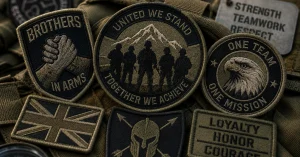
Some military units authorise morale patches during deployments or specific missions.
These patches may represent:
- Deployment operations
- Unit traditions
- Mission accomplishments
- Team spirit
Although not worn on every uniform, authorised morale patches can strengthen camaraderie within military units.
Why Correct OCP Patch Placement Is So Important
Wearing patches correctly isn’t simply about appearance.
Proper placement reflects discipline, attention to detail, and respect for military regulations. Every member of a unit is expected to maintain the same professional standard.
Incorrect placement may create confusion during operations and can negatively affect inspections.
Some of the biggest reasons correct placement matters include:
Professional Appearance
Uniformity is a defining characteristic of military service. Consistent patch placement helps every soldier present a clean, organised appearance.
Instant Recognition
Correctly positioned rank and identification patches allow military personnel to identify leadership roles and unit assignments quickly.
This becomes particularly valuable during exercises, deployments, and emergency situations.
Respect for Military Tradition
Military uniforms carry generations of tradition.
Following official placement standards demonstrates respect for the history, values, and customs of military service.
Improved Operational Efficiency
In challenging environments, soldiers often need to recognise one another instantly.
Properly positioned identification patches help improve communication while reducing confusion.
Choosing the Best Attachment Method
The way your OCP patch is attached is almost as important as where it’s placed.
Different attachment methods offer different advantages depending on how the uniform will be used.
Sew-On Patches
Sew-on patches remain the preferred choice for permanent military uniforms.
Advantages include:
- Exceptional durability
- Secure attachment
- Excellent resistance to washing
- Long service life
- Professional appearance
For uniforms worn regularly in demanding conditions, sewn patches are generally the most reliable option.
Velcro Backed Patches
Many modern OCP uniforms include hook-and-loop panels designed specifically for interchangeable patches.
Velcro-backed patches allow users to:
- Replace patches quickly
- Change unit identifiers
- Remove patches before laundering
- Adapt uniforms for different assignments
Because of this flexibility, hook-and-loop backing has become extremely popular on operational uniforms.
Iron-On Patches
Iron-on patches offer a quick application method but are generally less suitable for military clothing.
High temperatures, repeated washing, and demanding field conditions may weaken the adhesive over time.
Iron-on backing is better suited for casual garments than official military uniforms.
The Complete Guide to Army OCP Patch Placement
Now that you understand the purpose of each patch and the different attachment methods, it’s time to learn where every OCP patch belongs. Proper placement ensures a neat, professional appearance while complying with military uniform standards.
Although exact placement requirements can vary slightly depending on the branch of service or current regulations, the following guide reflects the most common layout used on modern OCP uniforms.
1. Name Tape Placement
The name tape is one of the easiest patches to identify on an OCP uniform. It displays the service member’s surname and allows quick identification without compromising the camouflage pattern.
Correct Placement
- Positioned above the right chest pocket
- Attached directly to the designated hook-and-loop (Velcro) panel
- Must remain centred and aligned with the pocket
The lettering should use authorised subdued colours that match the Operational Camouflage Pattern.
Why It Matters
A properly aligned name tape creates a clean appearance and helps fellow personnel identify one another during training, field exercises, and operational deployments.
2. Service Branch Tape Placement
Opposite the name tape is the service branch tape.
Instead of displaying the individual’s name, this tape identifies the military branch they belong to.
Examples include:
- Army
- Air Force
- National Guard
- Other authorised service branches
Correct Placement
- Positioned above the left chest pocket
- Centred on the designated Velcro panel
- Must sit level with the name tape on the opposite side
Balanced placement gives the uniform a symmetrical and professional appearance.
3. Rank Insignia Placement
Rank insignia identify leadership level and authority within the military hierarchy.
Every soldier immediately recognises the chain of command through these insignia.
Correct Placement
Depending on the uniform style, rank insignia may be positioned on:
- Centre chest Velcro panel
- Patrol cap
- Collar
- Epaulettes
The insignia should always be centred and securely attached.
An incorrectly placed rank patch can create confusion and may not comply with military dress standards.
4. Unit Identification Patch
The unit identification patch shows the division, brigade, regiment, battalion, or command to which a soldier belongs.
These patches strengthen unit pride while making personnel easy to identify during joint operations.
Correct Placement
Typically positioned on the:
- Left shoulder sleeve
The patch should sit squarely on the authorised hook-and-loop panel or be sewn neatly onto the sleeve where regulations require.
Keeping the patch level ensures a sharp military appearance.
5. Shoulder Sleeve Insignia
Some uniforms include additional shoulder sleeve insignia representing operational assignments or previous service.
These insignia often recognise participation in specific operations or wartime deployments.
Correct Placement
Usually worn on the:
- Right shoulder sleeve (when authorised)
Placement should remain centred within the designated sleeve panel.
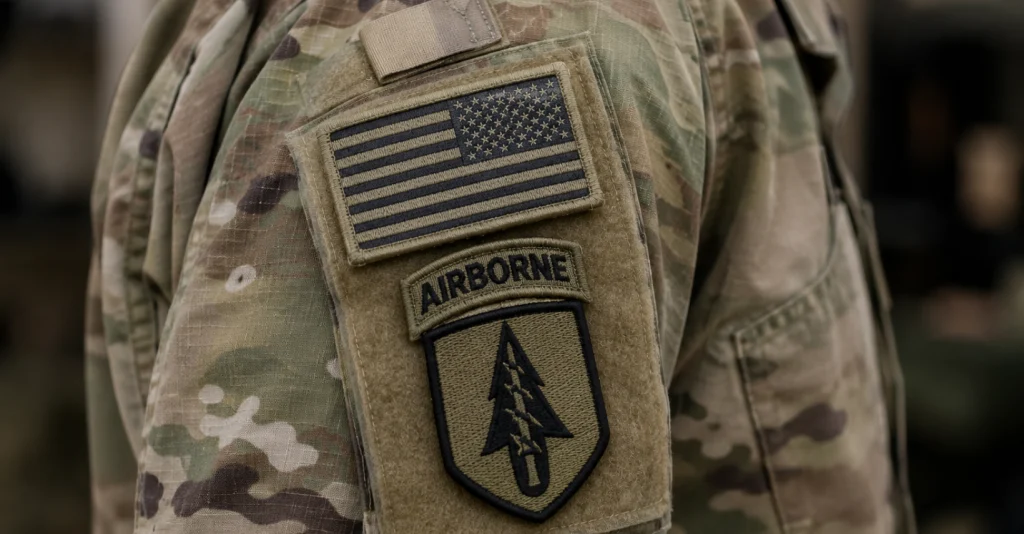
6. National Flag Patch
One of the most recognisable elements of an OCP uniform is the national flag.
The subdued flag helps identify nationality without compromising camouflage effectiveness.
Correct Placement
The flag patch is normally positioned on the:
- Upper right sleeve
- Directly on the designated Velcro panel
Many military uniforms use a reverse-oriented flag.
This design represents the flag appearing to fly forward while the soldier advances.
7. Skill and Qualification Badges
Military personnel who complete specialist training often earn qualification badges recognising their expertise.
These may include specialised schools, occupational qualifications, or advanced training achievements.
Correct Placement
Placement varies depending on:
- Type of badge
- Uniform style
- Military regulations
Typically, authorised qualification badges appear:
- On the chest
- Beneath authorised name or service tapes
- On designated Velcro locations
Only approved badges should be displayed.
8. Patrol Cap Rank Placement
The patrol cap also carries identifying insignia.
Correct Placement
Rank insignia should be:
- Positioned in the centre front
- Directly above the bill
- Evenly aligned
A crooked or off-centre rank patch can noticeably affect the overall appearance of the uniform.
Common OCP Patch Placement Mistakes
Even experienced collectors and uniform enthusiasts occasionally make placement errors.
Here are some of the most common mistakes to avoid.
Uneven Alignment
Patches should always sit perfectly straight.
Even slight tilting can make an otherwise professional uniform appear untidy.
Incorrect Sleeve Placement
Many people accidentally place shoulder patches too high or too low.
Always use the designated Velcro panel or follow official placement measurements.
Mixing Different Camouflage Colours
Every patch should match the Operational Camouflage Pattern.
Bright-coloured patches intended for dress uniforms should never be attached to OCP combat uniforms.
Poor Attachment
Loose stitching or worn Velcro can cause patches to sag or detach during use.
Regularly inspect your patches to ensure they remain securely fastened.
Using Unauthorised Patches
Only approved insignia should be worn on military uniforms.
Decorative or novelty patches should never replace official identification patches unless specifically authorised for morale purposes.
Tips for Keeping OCP Patches Looking Their Best
Military uniforms are exposed to demanding conditions, making proper care essential.
Follow these simple maintenance tips to extend the life of your patches:
- Wash uniforms according to the manufacturer’s care instructions.
- Close all Velcro fasteners before laundering.
- Avoid harsh bleach products that may fade embroidery.
- Trim loose threads carefully instead of pulling them.
- Store uniforms flat or hanging to prevent patch edges from curling.
- Replace worn hook-and-loop backing when necessary.
Proper care helps preserve both the appearance and durability of your patches for years.
Why Choose Custom Patch Makers UK?
At Custom Patch Makers UK, we understand that military-style patches demand exceptional quality, precision, and durability.
Our experienced team produces custom patches that combine professional craftsmanship with premium materials, making them suitable for collectors, cadet organisations, veterans, tactical teams, businesses, clubs, and promotional use.
We offer a wide range of customisation options, including:
- Premium embroidered patches
- Woven patches
- PVC rubber patches
- Velcro backed patches
- Sew-on patches
- Iron-on patches
- Custom name tapes
- Unit-inspired patches
- Tactical morale patches
- Fully personalised designs
Using high-quality threads, durable backing materials, and precision embroidery techniques, we create patches that are built to last while maintaining a clean, professional finish.
Whether you need a single custom design or a large production run, our team is committed to delivering outstanding craftsmanship and reliable service tailored to your requirements.
Frequently Asked Questions
1. Where should the flag patch be placed on an OCP uniform?
The subdued national flag patch is generally worn on the upper right sleeve of the OCP uniform using the designated hook-and-loop (Velcro) panel. Many military uniforms feature a reverse-facing flag to represent the flag moving forward as the wearer advances. Always follow your organisation’s current uniform regulations, as placement requirements may vary.
2. Where does the rank insignia go on an OCP uniform?
Rank insignia placement depends on the type of uniform being worn. On many modern OCP uniforms, the rank is displayed on the centre chest Velcro panel, while some uniforms place rank on the patrol cap, collar, or shoulder epaulettes. The insignia should always be centred, level, and securely attached.
3. Can I estimate the placement of my patches?
It’s best not to. Military uniforms follow precise standards, and patch placement should always be based on official measurements or designated attachment panels. Guessing the position can result in an uneven appearance or non-compliance with uniform regulations.
4. What’s the difference between a unit patch and a morale patch?
A unit patch identifies the military formation, battalion, brigade, or division to which a service member belongs and is considered an official part of the uniform.
A morale patch is generally used to represent unit spirit, mission identity, or achievements and is only worn when authorised. Morale patches should never replace official insignia.
5. Are Velcro patches better than sew-on patches?
Both options have their advantages.
Velcro patches are ideal when patches need to be changed frequently, such as during deployments, training, or reassignment.
Sew-on patches provide a permanent, highly durable solution that stands up well to frequent washing and demanding environments. Many military personnel prefer sew-on patches for long-term use.
6. Can I order personalised military-style patches?
Yes. At Custom Patch Makers UK, we produce high-quality custom military-style patches for collectors, cadet organisations, tactical teams, veterans, airsoft groups, businesses, and organisations. We offer complete customisation, including embroidered patches, PVC patches, woven patches, Velcro backing, iron-on backing, and sew-on options.
Final Thoughts
Correct OCP patch placement is about much more than appearance. Every patch on a military uniform represents identity, achievement, service, and professionalism. From name tapes and rank insignia to unit patches and national flags, each element has a designated position that contributes to a clean, consistent, and regulation-compliant uniform.
Understanding where each patch belongs not only improves the overall look of the uniform but also supports clear identification, strengthens unit cohesion, and honours long-standing military traditions. Whether you’re an active service member, a veteran, a cadet, or a military enthusiast, taking the time to position your patches correctly demonstrates respect for the uniform and the values it represents.
If you’re looking for premium-quality custom military-style patches, Custom Patch Makers UK is here to help. We specialise in designing and manufacturing durable embroidered, woven, PVC, Velcro, iron-on, and sew-on patches that combine outstanding craftsmanship with long-lasting performance. Whether you need custom name tapes, tactical patches, unit-inspired designs, or personalised insignia, our experienced team can create patches tailored to your exact requirements.
Choose quality, precision, and reliability with Custom Patch Makers UK your trusted partner for professionally crafted custom patches.